cAMP Hunter™ Human GIP (GIP Receptor) Gs Stable Cell Line Assay (CHO-K1)
The cAMP Hunter™ Human GIP (GIPR) Gs Stable Cell Line Assay (CHO-K1) contains a stable clonal cell line used to measure GIPR (GPCR) activity via increased levels of intracellular cAMP. This is a complete kit that includes the cell line vials, all required culture reagents for maintaining the cells in continuous culture, and detection reagents for running the assay.
Catalog #: 795-0146C2
Size: Kit
Unit Price: Contact For Pricing
Qty
Overview
Specifications
Documentation
Resources
Related Info
Biological Background
The GIP receptor (GIPR), a class A GPCR and key incretin hormone target, regulates insulin secretion, lipid metabolism, and energy homeostasis, making it a cornerstone for obesity, type 2 diabetes, and metabolic syndrome therapeutics alongside GLP-1R.
This cAMP Hunter™ Human GIP (GIPR) Gs Stable Cell Line Assay (CHO-K1, cat. no. 795-0146C2) leverages CHO-K1 cells for reliable detection of GIP-induced cAMP accumulation through native Gαs coupling and adenylyl cyclase activation.
The homogeneous EFC chemiluminescent format enables precise agonist/antagonist potency, efficacy determination, and rank-order profiling to support GIPR-focused drug discovery and multi-target incretin mimetic development.
Product Highlights
- CHO-K1 background for high-fidelity human GIPR Gs-coupled cAMP assays
- Detects ligand-driven intracellular cAMP changes with high sensitivity.
- Streamlined homogeneous EFC readout for scalable GPCR evaluation.
- Enables potency ranking and MOA insights for GIP therapeutics.
- Tailored for incretin and metabolic disorder research pipelines.
cAMP Hunter Human GIPR Gs Stable Cell Line Assay (CHO-K1) Assay Principle
In the cAMP Hunter Human GIPR Gs Stable Cell Line Assay (CHO K1), CHO K1 cells overexpressing human GIPR leverage the receptor’s natural Gαs coupling to monitor activation. When stimulated by GIP or related agonists, GIPR activates adenylyl cyclase, which catalyzes ATP conversion to 3′ 5′ cyclic adenosine monophosphate (cAMP). The resulting increase in intracellular cAMP is quantified using a homogeneous, gain of signal competitive immunoassay based on Enzyme Fragment Complementation (EFC) technology. Signal intensity correlates directly with cellular cAMP levels, such that greater GIPR activation produces higher cAMP concentrations and larger assay signals.

cAMP Hunter™ GIPR Dual Protocols: Suspension & Adherent
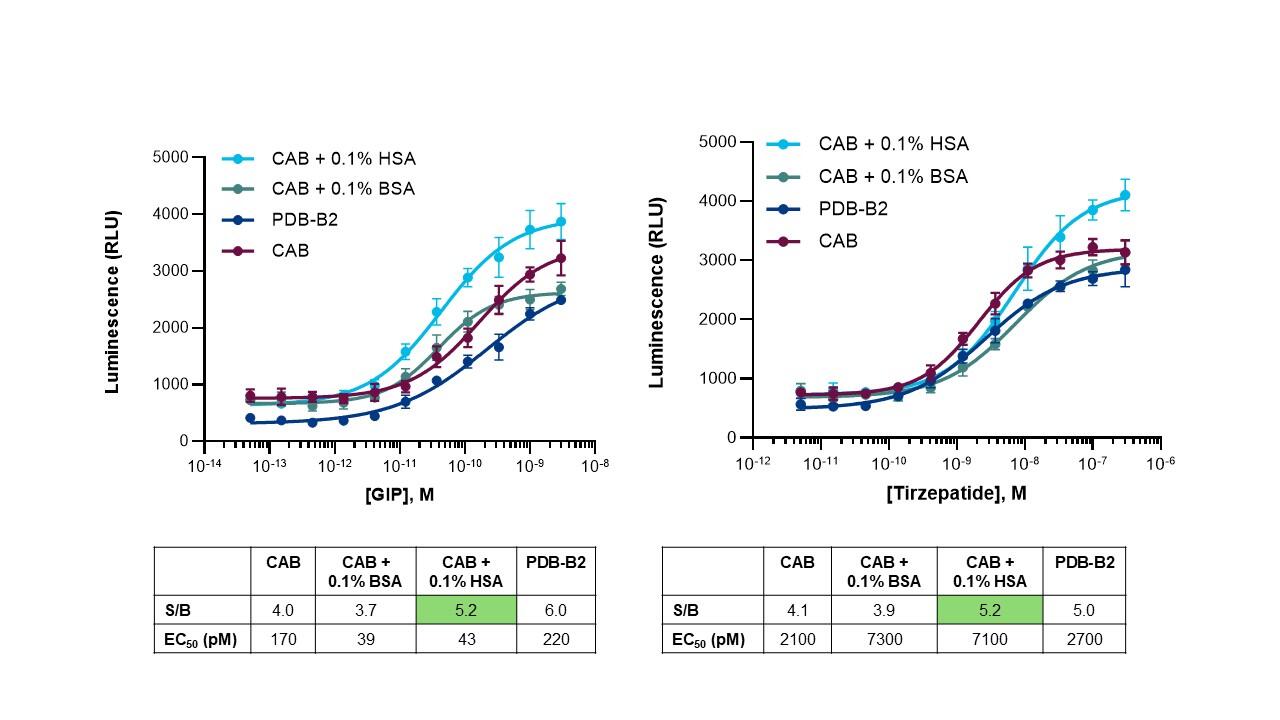
The cAMP Hunter™ Human GIP (GIPR) Gs Stable Cell Line Assay (CHO-K1, cat. no. 795-0146C2) offers dual-protocol flexibility: a traditional adherent mode for overnight cell attachment and standard workflows, and a streamlined suspension mode for same-day results in ~3 hours with reduced hands-on time. Both deliver close potency (e.g., GIP EC50), high signal-to-background ratios, and seamless EFC-based cAMP detection, validated specifically for this GIPR line to support HTS, automation, or routine screening.

Suspension mode eliminates overnight plating by seeding cells directly into cAMP Cell Assay Buffer, enabling faster turnaround without compromising data quality.
Typical Results: Suspension vs. Adherent
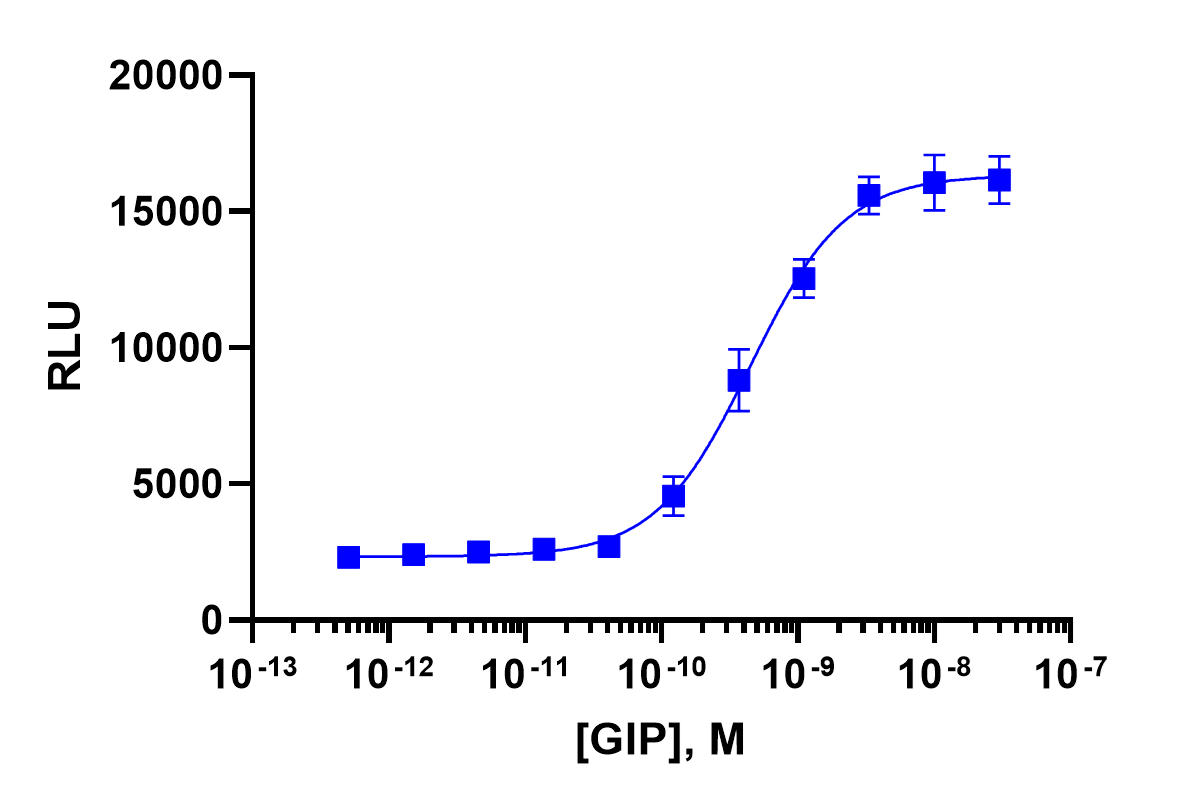
The following graphs show typical results obtained on cAMP Hunter GIPR Gs Cell Line (CHO-K1) with the cAMP HitHunter kit using two different workflows, demonstrating robust performance regardless of the workflow chosen.


Typical results obtained on cAMP Hunter GIPR Gs Cell Line (CHO-K1) (#795-0146C2). GIP dose-response curves generated using cAMP HitHunter kit in adherent mode (A.) and suspension mode (B.).